About our Research |
Latest News |
Contact Us |
||||||||||
|
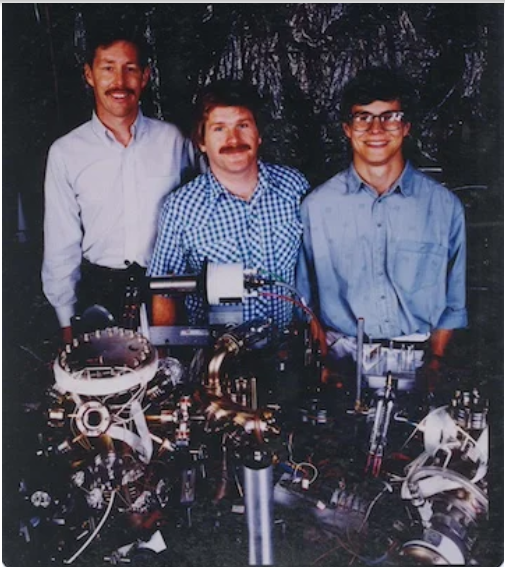
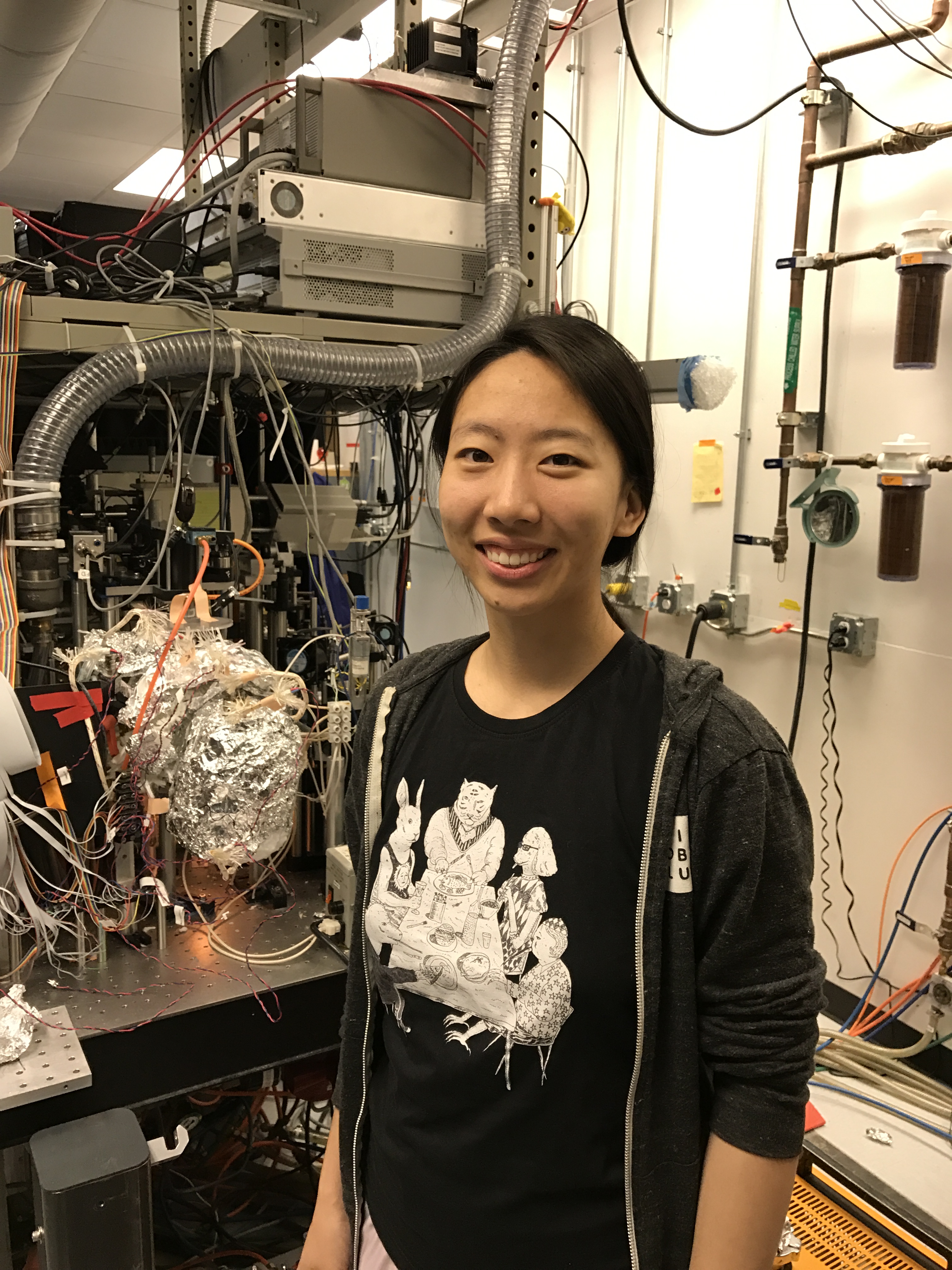
The Hulet group uses ultracold lithium atoms to explore quantum many-body phenomena. Using optical lattices, we confine atomic fermions to periodic potentials or to low-dimensions where strong correlations and emergent behavior arise. The extreme tunability of lattice parameters, density, and even geometry, fulfills the requirements of a versatile analog quantum simulator …. click to continue reading Recent PublicationsThermal disruption of a Luttinger liquid:Danyel Cavazos-Cavazos*, Ruwan Senaratne*, Aashish Kafle, and Randall G. Hulet, Nature Communications volume 14, Article number: 3154 (2023) – Published 31 May 2023 Full Text Spin-charge separation in a 1D Fermi gas with tunable interactions:Ruwan Senaratne*, Danyel Cavazos-Cavazos*, Sheng Wang, Feng He, Ya-Ting Chang, Aashish Kafle, Han Pu, Xi-Wen Guan, and Randall G. Hulet, Science, 376, 6599 (2022) – Published 16 June 2022 PDF Collisional Loss of One-Dimensional Fermions near a p-Wave Feshbach Resonance:Ya-Ting Chang, Ruwan Senaratne, Danyel Cavazos-Cavazos, Randall G. Hulet, Phys. Rev. Lett. 125, 263402 – Published 30 December 2020 PDF Creation and Characterization of Matter-Wave Breathers:De Luo, Yi Jin, Jason H. V. Nguyen, Boris A. Malomed, Oleksandr V. Marchukov, Vladimir A. Yurovsky, Vanja Dunjko, Maxim Olshanii, R. G. Hulet, Phys. Rev. Lett. 125, 183902 – Published 30 October 2020 PDF Quantum Fluctuations of the Center of Mass and Relative Parameters of Nonlinear Schrödinger Breathers:Oleksandr V. Marchukov, Boris A. Malomed, Vanja Dunjko, Joanna Ruhl, Maxim Olshanii, Randall G. Hulet, and Vladimir A. Yurovsky, Phys. Rev. Lett. 125, 050405 – Published 28 July 2020 PDF Methods for Preparing Quantum Gases of Lithium:Randall G. Hulet, Jason H. V. Nguyen, and Ruwan Senaratne, Review of Scientific Instruments 91, 011101 (2020) PDF Correlations generated from high-temperature states: Nonequilibrium dynamics in the Fermi-Hubbard model:Ian G. White, Randall G. Hulet, and Kaden R. A. Hazzard, Physical Review A 100, 033612 (2019) PDF Splitting of nonlinear-Schrödinger breathers by linear and nonlinear localized potentials:Oleksandr V. Marchukov, Boris A. Malomed, Vladimir A. Yurovsky, Maxim Olshanii, Vanja Dunjko, and Randall G. Hulet, Physical Review A 99, 063623 (2019) PDF Parametric Excitation of a Bose-Einstein Condensate: From Faraday Waves to Granulation:J.H.V. Nguyen, M.C. Tsatsos, D. Luo, A.U.J. Lode, G.D. Telles, V.S. Bagnato, and R.G. Hulet, Physical Review X 9, 011052 (2019) PDF Supplemental Materials Measurement of the Dynamical Structure Factor of a 1D Interacting Fermi Gas:T. L. Yang, P. Grisins, Y. T. Chang, Z. H. Zhao, C. Y. Shih, T. Giamarchi, and R. G. Hulet, Physical Review Letters 121, 103001 (2018) PDF Supplemental Materials Dissociation of One-Dimensional Matter-Wave Breathers due to Quantum Many-Body Effects:Vladimir A. Yurovsky, Boris A. Malomed, Randall G. Hulet, and Maxim Olshanii, Physical Review Letters 119, 220401 (2017) PDF |
|
Mailing Address6100 Main Street Physical AddressBrockman Hall for Physics Lab Phone713-348-2663 Contact Randall Hulet713-348-6087 (phone) 713-348-5492 (fax) |